
Kendriya Vidyalaya Schools to Introduce Mandatory Sanskrit Sections by 2026-27
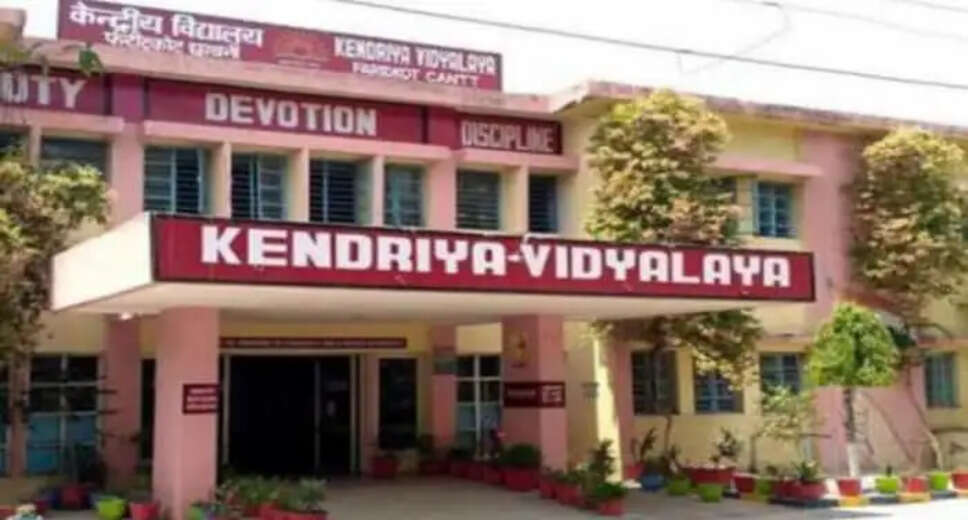
New Language Policy for Kendriya Vidyalayas
New Delhi: The Kendriya Vidyalaya Sangathan has announced a new requirement for its schools to include at least one section for Sanskrit in classes VI and IX, as part of the third-language framework set to be implemented in the 2026-27 academic year.
In a circular released on May 29, the autonomous organization under the Ministry of Education instructed all Kendriya Vidyalayas to gather preferences from students and parents regarding the third-language options.
The third language can be either Sanskrit or a regional language from the scheduled languages, distinct from the first two languages (Hindi and English).
A senior official stated, "Students may choose either Sanskrit or a regional language according to their preference, but every school must have at least one Sanskrit section to support children of transferable employees."
The KVS has also requested data on students' choices for the third language through the Samagam portal to adjust staffing needs at each school.
The circular mandates that all schools report the data for merged sections of Sanskrit and regional languages separately, based on the third language selected by students in classes VI and IX.
"Students selecting the same R3 language should be grouped in the same section to ensure smooth class operations," the circular emphasized.
It provided examples for organizing language sections, noting that the number of sections for Sanskrit and regional languages will depend on student enrollment. In schools with only one section, separate batches for Sanskrit and regional languages may be created, provided there are at least 15 students.
For schools with two sections, one for Sanskrit and one for a regional language will be maintained. In schools with three sections, principals can determine the allocation of Sanskrit and regional language sections based on student preferences, but at least one Sanskrit section is required in each class.
Recently, the CBSE announced that starting July 1, the study of three languages, including at least two native Indian languages, will be compulsory for Class IX students.
This initiative aligns with the CBSE's efforts to conform to the National Education Policy (NEP) 2020 and the National Curriculum Framework for School Education (NCF-SE) 2023.
According to a circular from the board dated May 15, students wishing to study a foreign language may do so only as their third language after completing two native Indian languages or as an additional fourth language.
To alleviate pressure on students, the CBSE has stated that no board examination will be held for the R3 language at the Class-X level.
Until dedicated R3 textbooks are available, Class IX students will use the Class VIII R3 textbooks (2026-27 edition) for their chosen language.