
Is Kenadhipa Upgraded High School in Sambalpur District Failing Its Students?
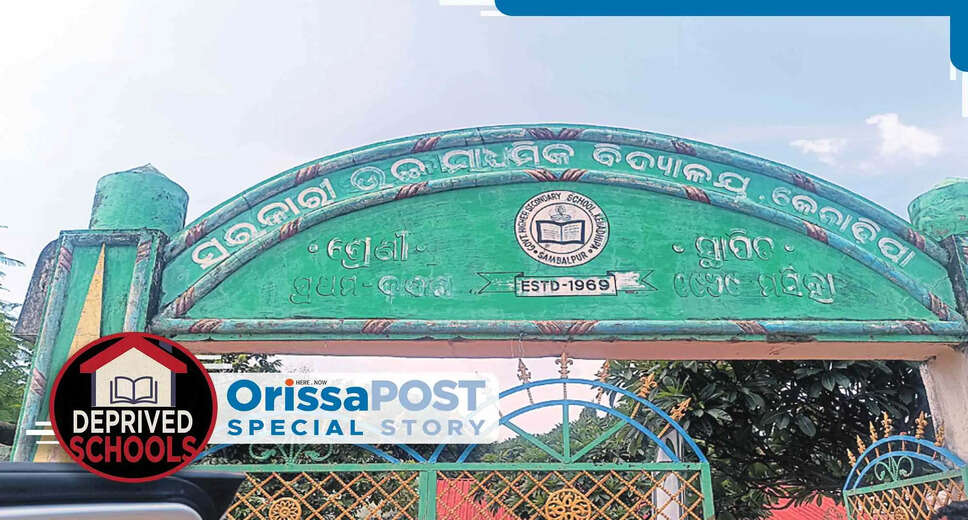
Challenges Faced by Kenadhipa Upgraded High School
By Rabindra Prasad Dani
Jamankira: Despite promises of educational advancement and school improvements, the reality at Kenadhipa Upgraded High School in the Jamankira block of Sambalpur district tells a different story.
Founded in 1969, this institution grapples with significant infrastructure issues and a lack of teaching staff. Efforts made under the 5T school transformation initiative have not sufficiently resolved critical problems, such as inadequate classroom space and the absence of basic amenities like drinking water and sanitation facilities.
Students are compelled to learn in classrooms with damaged ceilings, and there are no teachers available for the primary grades. Currently, 324 students from Class I to XII are enrolled across 13 classes, with 77 residing in the school hostel.
The school requires at least 13 distinct classrooms, yet only seven are available. Consequently, students from different grades must share the same space. This situation worsens during the summer months when the low tin roofs make the classrooms uncomfortably hot for both students and teachers.
In the rainy season, water leaks into all classrooms, leading to damp and deteriorating walls. Some ceilings have collapsed, and many others are in precarious condition, posing a serious risk to student safety.
Official records indicate that 17 teachers, including the headmaster, are assigned to the school. However, there are no teachers for Classes I to V, which are crucial for foundational education. Additionally, only two female teachers are available for Classes VI to VIII.
Due to the lack of classrooms and teachers, younger students are forced to sit on mats on the floor, facing challenging learning conditions. The school's basic facilities are also in disrepair; for instance, the girls' toilet door is broken, rendering it unusable due to unsanitary conditions.
Moreover, students experience a severe shortage of drinking water. The kitchen, intended to serve a large student body, is in an unhygienic state, complicating the preparation of midday meals. The protective wall surrounding the school is damaged, increasing the risk of disturbances from outsiders.
The school grounds are littered with garbage. Balaram Majhi, the president of the school management committee, and vice-president Annapurna Bhatt have voiced their concerns regarding the school's condition. They noted that both the Block Education Officer (BEO) and District Education Officer (DEO) have been informed about these issues multiple times, yet no action has been taken.
Headmaster Subhranshu Panda has also expressed worry that these ongoing problems are negatively impacting students' education. When approached, Jamankira Assistant Block Education Officer (ABEO) Debaki Naik and Sambalpur DEO Laxman Kumar Bhoi acknowledged the school's challenges.
They assured that all infrastructure-related issues, including the construction of additional classrooms and repairs to toilets, would be addressed soon under the Viksit Bharat Guarantee for Rozgar and Ajeevika Mission-Gramin (VB-G RAM G) scheme. They also mentioned that efforts would be made to fill the vacant teaching positions.