
NCERT Introduces Emergency Topic in Class 9 Social Science Curriculum
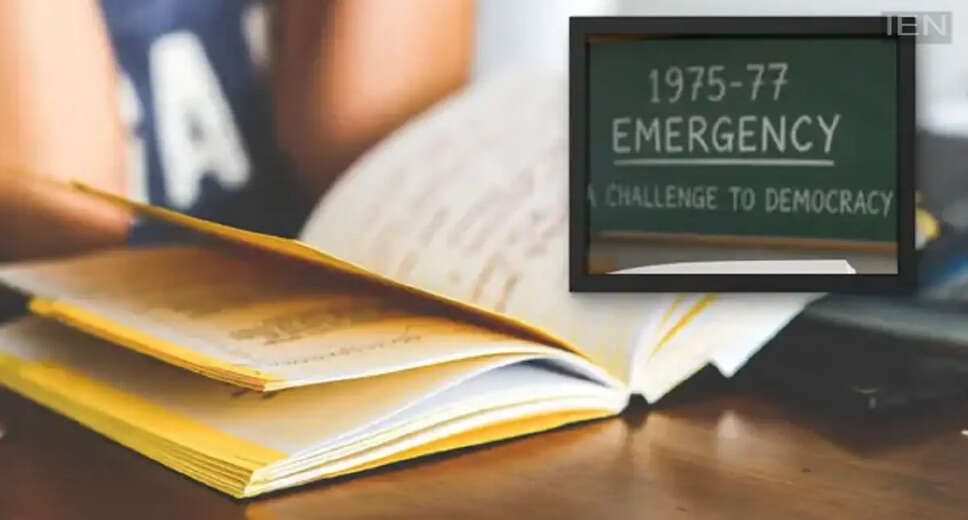
Introduction of Emergency in Class 9 Curriculum
The National Council of Educational Research and Training (NCERT) has made a significant update to the Class 9 Social Science syllabus by incorporating a section on the Emergency, which took place nearly 50 years ago. This addition aims to educate students about this critical period in Indian history.
The Emergency topic is featured in the chapter titled "Challenges to Democracy." This marks the first time that Class 9 students will receive comprehensive insights into the Emergency, with the goal of enhancing their understanding of the challenges and strengths of Indian democracy.
Details of the New Textbook
The Emergency will be discussed in the newly released textbook named "Understanding Society: India and Beyond." This book elaborates on the workings of Indian democracy, its defining characteristics, and the various challenges it encounters.
It emphasizes that democracy extends beyond just electoral processes; it also encompasses civil rights, freedoms, and the robustness of constitutional institutions. Within this framework, the Emergency is portrayed as a significant trial for Indian democracy.
Overview of the Emergency
The textbook outlines that in the early 1970s, widespread protests emerged due to issues like unemployment, inflation, and dissatisfaction with the government. In response to these internal disturbances, a national Emergency was declared in June 1975.
During this period, numerous fundamental rights were curtailed, press censorship was enforced, and many political leaders and activists were detained. This era saw democratic institutions facing immense pressure, leading to a decline in civil liberties.
Jayaprakash Narayan's Influence
The new textbook also highlights the pivotal role of Loknayak Jayaprakash Narayan, who galvanized students and citizens to participate in large-scale movements. His leadership was instrumental in organizing significant protests, particularly in Bihar and Gujarat, which bolstered the opposition against the Emergency.
In addition to the Emergency, the NCERT book addresses various other challenges to democracy, including the proliferation of fake news, misinformation, poverty, regionalism, social discrimination, gender inequality, damage to public property, and the neglect of civic duties.