
Controversy Surrounds NCERT's New Art Education Book Featuring 'Dancing Girl'
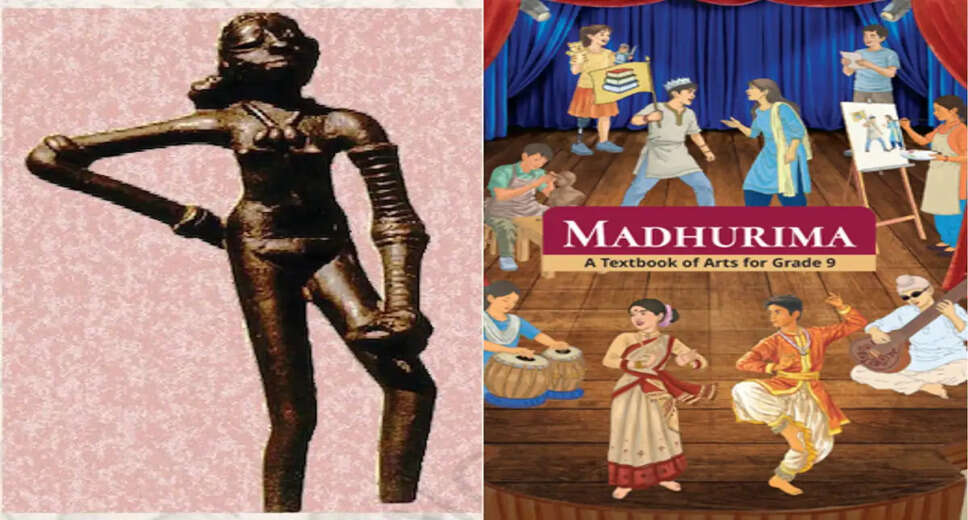
Debate Over 'Dancing Girl' Depiction in NCERT Textbook
A significant controversy has arisen regarding *Madhurima*, the latest Class 9 Art Education textbook released by the National Council of Educational Research and Training (NCERT). The issue revolves around the portrayal of the renowned bronze statue from Mohenjo-daro, famously known as the 'Dancing Girl.' In this new edition, the statue's previously nude torso has been altered to appear clothed, which marks a notable shift from earlier versions where it was depicted in its authentic, unclothed form. This iconic artifact from the Indus Valley Civilization has been presented in its original state in NCERT textbooks for nearly 25 years, making the recent change a topic of heated discussion.
Ved Prakash, a former Under Secretary at NCERT, has voiced his disapproval of this modification. He has raised concerns about the rationale behind the decision to cover the 'Dancing Girl.' Let's delve deeper into this issue.
"Cultural Artifacts Should Remain Untouched"
Ved Prakash has criticized the choice to clothe the 'Dancing Girl.' In an interview, he emphasized that this statue, which is over 4,500 years old, has been consistently featured in NCERT materials for the last quarter-century. He noted that the same image appears in the Class 6 textbook without any controversy regarding its nudity, yet in the Class 9 edition, the upper torso is obscured—a change he considers unnecessary. He argued for a consistent policy across both educational levels, asserting that altering cultural artifacts could mislead people into thinking the statue is a replica rather than an authentic piece.
Prakash elaborated on the decision-making process that led to the alteration of the 'Dancing Girl' in the textbook. He explained that the content of NCERT books is developed through a multi-step process. Following the implementation of the National Education Policy (NEP) 2020, NCERT established the National Curriculum Framework, which outlines the educational curriculum and the nature of textbooks.
An expert committee, consisting of specialists in the relevant subjects, is formed to create the content, with each subject having its own committee and chairperson. This is followed by a review committee that evaluates the content for cultural sensitivity and appropriateness, ensuring it does not offend any community or contain inappropriate material.
Finally, an academic committee at NCERT validates the material before it goes to print. This process is a collaborative effort rather than the decision of a single individual, with academics playing a crucial role and no government interference involved.